It's been about ten days since the end of Marmomac 2026, and like every year, we take a moment to reflect on the past months and to what's ahead.
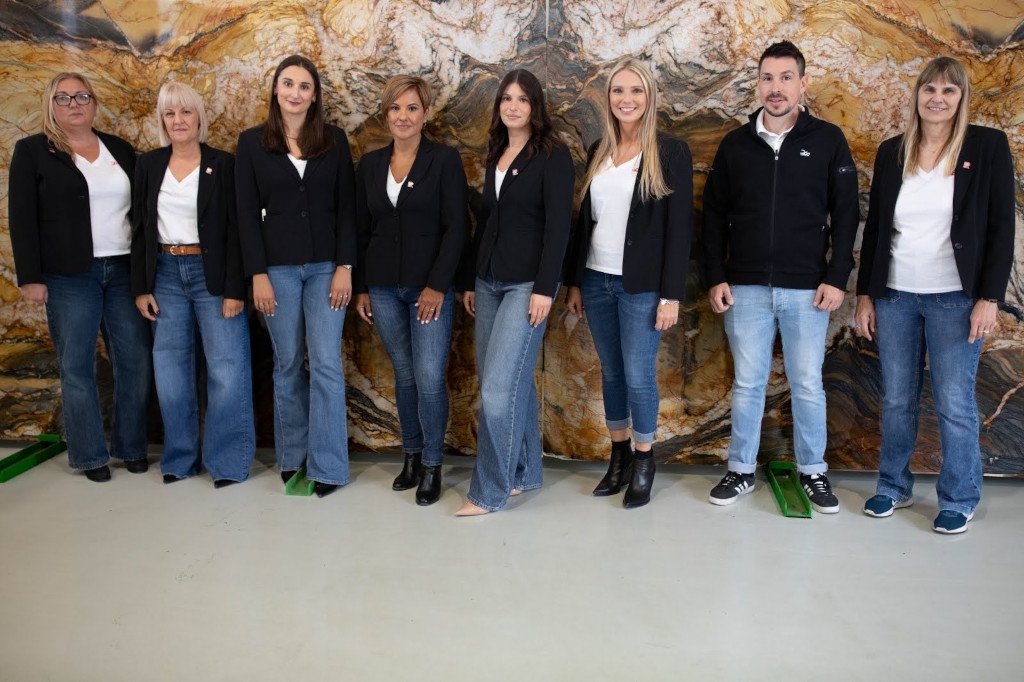
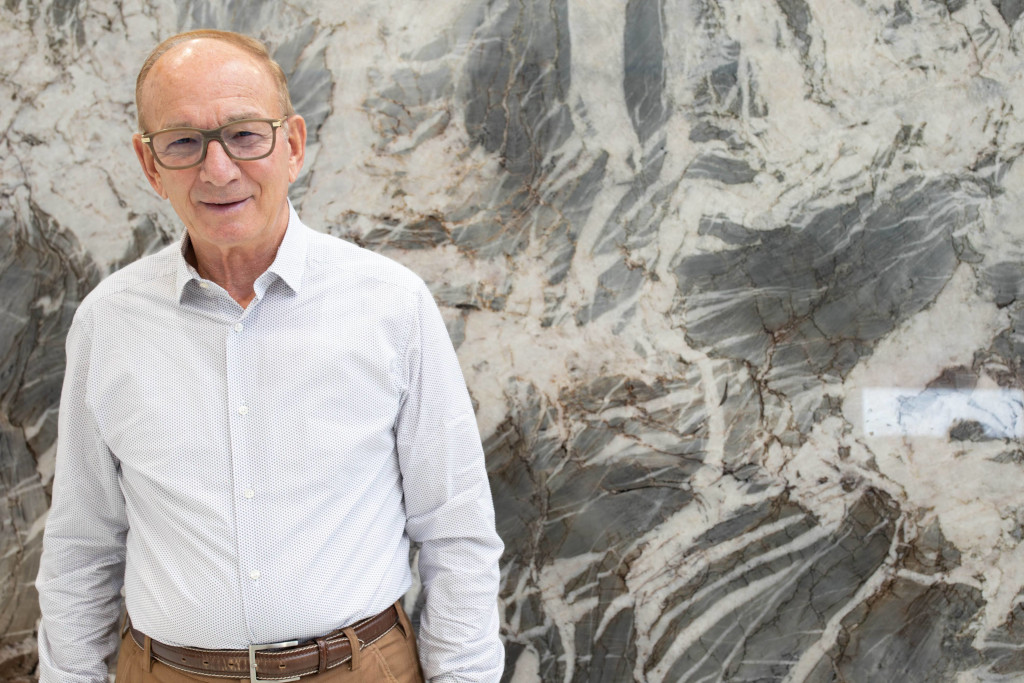
This year, on the company's 60th anniversary, we deliberately reached out to the people who are in the frontline of the company's management today. We asked questions to Mr. Giovanni, CEO of Marmi Rossi, Mirco, who takes care of the commercial area and interacts daily with Italian and foreign customers, Adelino, who looks after relationships with Italian customers and manages the containers for America, as well as Claudio and Valeria, who work in the administrative and organizational area.
These five people hold the company’s key positions and they told us from their perspective how they experienced these months of 2026 sharing their thoughts on Marmi Rossi's sixty-year history.
(Giovanni Rossi is speaking)
Last year, there was a decline in the European market, with France down 50% and Germany down 10%; the trend was leaning towards developing overseas markets in the USA, Canada, and Australia. How would you assess the state of the market twelve months later? Is the strategy of commerce in the non-European markets bringing the results you expected?
The situation in the European market has improved: orders from the Netherlands and Switzerland, Germany, France, and Poland have increased by over 20%. In the United Kingdom, however, we have noticed a significant deterioration, but we cannot explain the reasons.
Twelve months later, we can confidently say that the overseas market in the US and in Australia is very satisfying for us, especially the Australian market since it's new. The results meet our expectations, and requests are constantly increasing. Our goal now is to keep pushing in the American market, without of course losing sight of Australia.
The current situation is well-known to all of us: wars, expensive fuel, rising transport and raw material costs… Customers are cautious, and only a few feel like buying; at the stone fair, we didn't see the big orders we used to get.
Luckily, the natural stone market is holding up. From January until now, we've noticed a percentage increase in sales, which was confirmed after the stone fair, as many requests turned into orders, especially regarding quartzite and mainly Taj Mahal.
The 60th edition of the fair Marmomac ended on September 25 with over 1,300 exhibitors from 54 countries and 50,000 trade visitors from 132 countries. Compared to 2025, the number of buyers from Turkey (+20%) and India (+16%) increased, and the B2B meetings organized before the opening reached over 3,200, compared to 2,200 in the previous year. Veronafiere talks about better-prepared buyers with real purchasing power. Did you feel this atmosphere at the MeetUp too? How was the visitor turnout compared to the more hesitant visitors last year?
The perception at Marmomac is different than at Marmi Rossi: we didn’t get the same impression as the people at the fair. In fact, people came from Turkey and India not as buyers but as sellers.
We can't say much about the visitor numbers. Compared to past years, we've noticed a drop in the sales of marble and granite (excluding black natural stones like Zimbabwe and Impala), while the demand for quartzite has increased. Buying behaviour has also changed, as – like I said – it's being slowed down by the uncertainty of the overall crisis and, above all, by the wars.
For now, it's just wait and see: October will show us the exact sales results from the trade fair days.
The currently most in-demand natural stone is quartzite. Nero Assoluto, Zimbabwe, and Nero Impala confirm the trend with a slight increase in sales. Indian granites, on the other hand, are sharply declining.
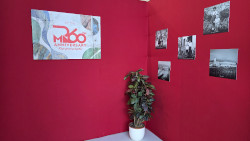
This year, Marmi Rossi has celebrated its 60th company anniversary, exactly in the same year as the 60th edition of the fair Marmomac. Looking back, what has changed the most in your profession, and what has stayed the same since 1966? And what do you wish for your company in the years to come?
Over the years, there have been major product changes at Marmi Rossi: in the beginning, we produced cut to size, but today we exclusively sell slabs.
Even raw materials and machines have changed, and technologies are becoming increasingly advanced: from steel frames to multi-wire machines with ever thinner diamond wires, which today allow us to optimally cut quartzite without breaking it.
And in the next few years? We hope to continue our current path and keep increasing revenue. This is necessary to cover personnel costs and buy new, ultra-modern machines, whose prices have risen steadily in the last few years. How do we plan to do that? By expanding into new markets (and here come the new resolutions for the coming months, editor's note).
(Claudio Rossi is speaking)
You’ve experienced an important part of these 60 years firsthand.
Is there a moment, a decision, or a memory that you think best tells the story of Marmi Rossi, or a reason why the company has come so far?

Actually, there isn't a specific moment, but rather an attitude, which I'd like to explain with an example.
In the year Marmi Rossi was founded, the first grandchild was also born, and we lived in a house where the eleven of us had to share three bedrooms. That's proof that we can handle any event and spare no effort while adapting.
This is how we were able to keep up with the changes in the region and in the markets, both in terms of raw materials and technologies. I would also add a good dose of intuition and a certain amount of courage to seize the moment, without ever living beyond our means or overestimating ourselves. That's a skill not everyone has. We have always acted as a family, without fights or company splits.
That's exactly what has allowed us to get this far and make all of Papa Maurizio's dreams come true.
(Adelino Rossi is speaking)
On October 6th, you’ll turn 60, just like Marmi Rossi: you’re practically the same age! Every day, you take care of the Italian customers and the management of the containers being shipped to America. The company will continue to rely on this market. What does it mean for you to celebrate this milestone together with the company? And what, in your opinion, do customers demand today compared to previous years?
When someone asks me how I’ve spent my sixty years, I often answer that I didn’t go to kindergarten but went straight into business!
The customers? They always ask us for high-quality materials because they're constantly looking for the wow factor, especially the American customers. Unfortunately, the demand in the English and Polish markets was quite low.

(Mirco Rossi is speaking)
You are in contact with customers from Italy and abroad every day. Last year, quartzites were absolutely at the centre of attention, and the online warehouse established itself as a supplementary sales channel.
What trends do you see this year in customer requests regarding materials, markets, and purchasing methods?
We have noticed a clear increase in demand for quartzite, especially for Taj Mahal, which is also the most sought-after material this year: its neutral colour, which is highly appreciated, does not follow current fashion trends.
Over time, we’ve also noticed that the kind of customer service varies depending on the market: in Europe, people prefer a direct relationship with the supplier, while in the US, often just an email with updates is enough to spark interest.
However, during the fair Marmomac, we didn't notice an increase in customers. Unfortunately, only a few customers have visited the fair, and the few visitors didn’t make any purchases. For many of them, it's no longer worth coming in person during the exhibition days and leaving their own business: nowadays, people buy what they need and avoid stockpiling materials in their warehouses.
(Valeria Rossi is speaking)
Marmi Rossi is a company where several generations of the family work together.
What does it mean to you, in daily work life and in dealing with customers and employees, to be part of the 'big Rossi family'?
Working together isn't always easy: different generations, but especially different personalities, sometimes have a hard time getting along. The biggest challenge is finding common ground, but in the end, we've always managed. That's exactly why the family has stayed together, and the business has been able to keep growing.
When it comes to customers, suppliers, and employees, I think it's most important to build a human relationship based on mutual trust. This value has always been with us and was fundamental to the way my grandfather Maurizio worked, who used to seal agreements with a handshake.