
The Pantone Colour of 2026, called Cloud Dancer, reflects a growing desire for lightness, balance, and well-being in the architecture industry. It is not sterile or absolute white but rather a soft, light hue that interacts with light and material.
In the stone industry, this current colour trend finds an authentic match in white marbles, light quartzites, and dolomites – all these materials have represented aesthetic and technical excellence ever since.
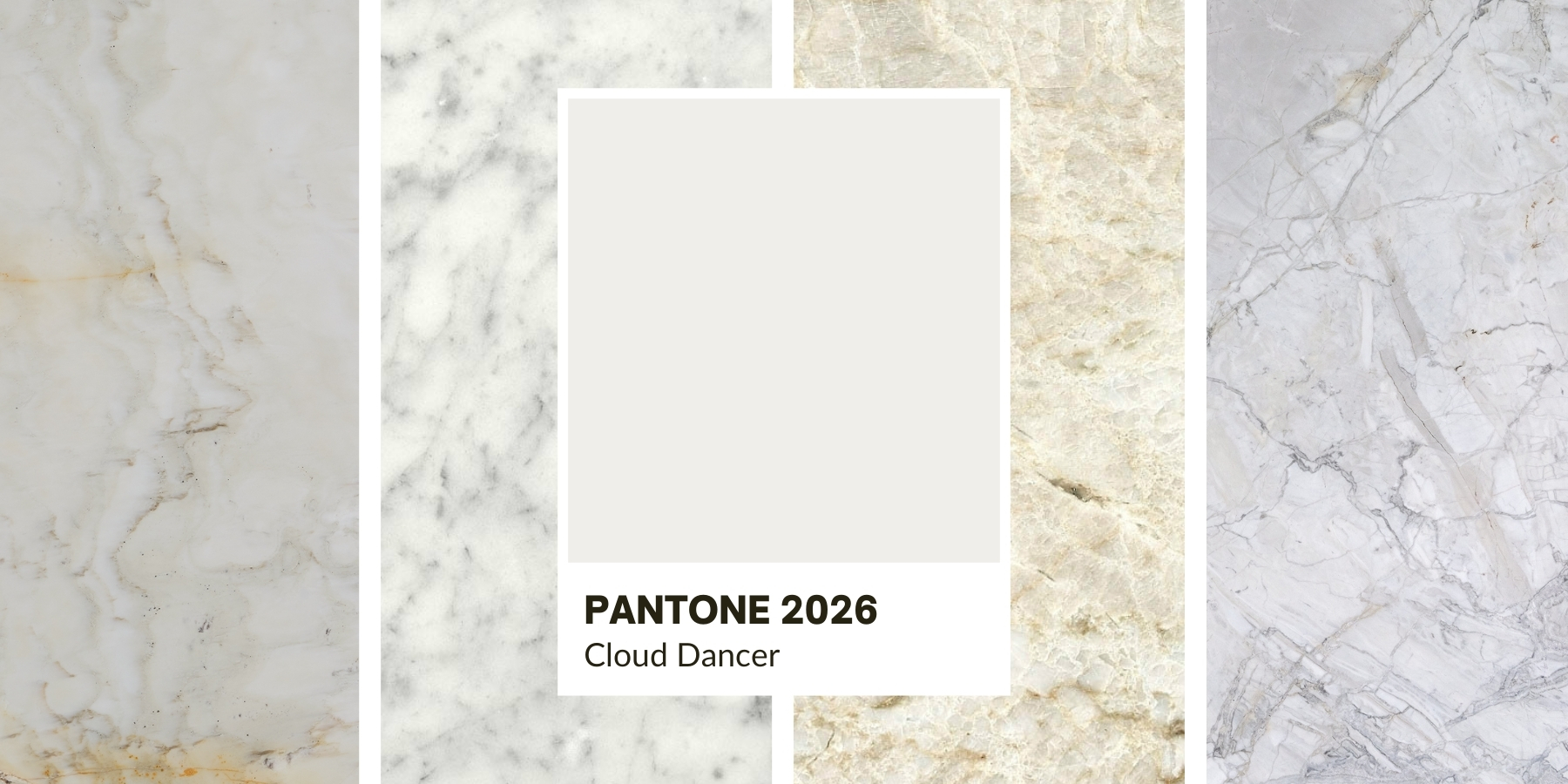
White marble, quartzite, and dolomite in comparison
When discussing white materials, it’s important to distinguish between colour origin and colour type. Not all shades of white are the same, as the white colour of natural stone is determined by its mineral composition.
Talking about white marble, such as Bianco Carrara, Bianco Statuario, or Calacatta, the colours depend primarily on the concentration of calcium carbonate. White colour can occur in purer hues - as with veinless white marble - or show distinctly graphic patterns, which is typical of veined white marble with a strong distinguishing feature. That’s why white marble slabs tell a double story: one about the essentials, the other about the natural movement of the material.
In contrast, the light colour of white quartzites is primarily due to quartz, an extremely resistant mineral. Quartz gives the surface a luminous yet solid appearance; this material is often chosen for contemporary projects, thanks to the frequent presence of fine veins or transparent areas.
Dolomite owns its colour to the mineral dolomite, which produces elegant and refined white hues so that the material almost looks like marble, yet with different properties. Dolomite offers perfect balance between aesthetics and performance, making it an ideal material when elegance and durability are required.
Due to its granular structure, granite naturally tends towards darker shades. There are some lighter granites, such as Bethel White and Bianco Sardo, but one can no longer speak of pure white.
Surface treatment of marble: how white colour tones can change a surface
The choice of surface finishing is crucial for showcasing white marble and light-coloured natural stones to their best advantage. A polished surface emphasises the vibrancy of colours and highlights veins and crystals but can sometimes be too reflective. For this reason, a satin surface is often preferred to enhance the material’s brilliance without pronouncing the mirror effect, while conveying a more natural feeling.
For indoor and outdoor flooring, which are subjected to heavy use, honed or satin surfaces are often the better choice, as they combine aesthetics, safety, and easy maintenance. Granites with lighter colours can also be flamed, which is a good solution for flooring and outdoor cladding.
Use of white material in architecture: light, space, and well-being
White materials are used both indoors and outdoors, with different but equally effective results.
In Arab countries, for example, white marble is traditionally used outdoors because of its ability to reflect sunlight, which helps keep buildings cooler. This functional use demonstrates how closely beauty and physical properties of natural stones are connected.
Indoors, light colours enhance the perception of space: surfaces made of white marble or light quartzite help to visually ‘enlarge’ a room, making it appear brighter and airier. Therefore, white marble is particularly suitable for smaller spaces.
Colour psychology also plays a significant role. Light, cool colour shades – such as glacier white or greyish white – convey freshness and lightness, while warm, light colour hues – such as cream or ivory - evoke a feeling of coziness.
Thanks to its countless variations, natural stone allows you to choose not only the colour but also a special atmosphere.
Visit our online catalogue to check all our white materials.